
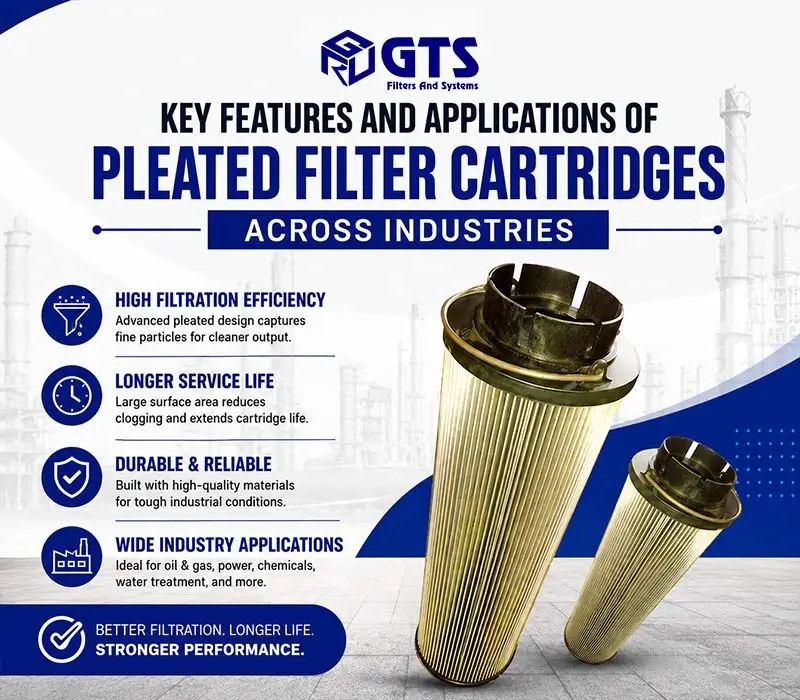
Nobody notices a filter until it stops working. That is just how it goes in industrial operations. The filter does its work, and nobody pays it much attention, until a product batch fails inspection, a downstream membrane fouls ahead of schedule, or a machine starts showing wear that nobody can immediately explain. When that happens, the investigation almost always leads back to filtration. Either the wrong filter was selected, or the one being used was not suitable for the task you were performing.
That is the problem pleated filter cartridges were built to solve. Better filtration area, longer life, more consistent performance. Industries from water treatment to pharmaceutical manufacturing have been using them for decades because they simply work better than the alternatives for most applications. This article explains how they work, what makes them different, and where they are used.
What Is a Pleated Filter Cartridge?
Picture a sheet of paper folded back and forth into a fan shape. That is essentially what happens to the filter membrane inside a pleated filter cartridge. The membrane gets folded into tight accordion-style pleats along the full length of a cylindrical body. Those folds are the whole point.
A flat membrane can only offer so much filtration area within a given housing size. But fold that same membrane 30, 40, or 60 times, and the active surface area multiplies. A 10-inch filter cartridge offers 3 to 5 times more filtration surface than a standard melt-blown or string-wound cartridge of the same dimensions.
Now, why does this surface area matter is because more surface means the cartridge can trap more particles before it fills up and needs replacing. That means it runs longer between changeouts. Fewer changeouts mean less downtime and lower maintenance costs, which is the outcome everyone is looking for.
Fluid enters from outside the cartridge, passes through the pleated membrane, and comes out clean through the centre. Anything above the cartridge’s rated particle size gets caught in the membrane and stays there.
Key Features Worth Understanding
Most people evaluating filter cartridges focus on price first. That is understandable, but the features are what actually determine whether the cartridge works for your application or creates problems down the line. Features and Advantages of Pleated Filter Cartridge are:
- Much More Surface Area in the Same Space: This is the feature that everything else follows from. The pleated structure packs far more membrane into the same housing footprint compared to a wound or melt-blown cartridge. That extra surface area means the cartridge holds more contaminants before the pressure rises too high. For a plant running around the clock, that extra time consumed between changeouts matters; it keeps the process running and keeps technicians doing more useful work than swapping filters.
- Nominal and Absolute Ratings: Not all pleated filter cartridges filter in the same way. Nominal-rated cartridges remove most particles above a stated size. They work well for general prefiltration and clarification duties where you do not need a hard guarantee. Absolute-rated cartridges guarantee that no particles larger than the stated size get through. That level of certainty is required in industries like pharmaceuticals, food production, and electronics manufacturing, where even a single contamination event can mean a batch rejection or a compliance failure.
- The Right Material for Every Fluid: The membrane inside the cartridge must be compatible with the fluid passing through it. The most common material options are:
- Polypropylene (PP)– Works well for most water-based fluids, is affordable, and is widely available
- PTFE– Handles strong acids, aggressive solvents, and oxidising chemicals
- PVDF– Used in pharmaceutical and industrial applications needing high chemical resistance
- Nylon– Suited to biological media and water-based process streams
- Glass fibre– Holds a lot of dirt before loading, commonly used before a finer membrane
- PFA– For semiconductor and electronics manufacturing, where ultra-pure filtration is needed
Picking the wrong material is the most common reason a cartridge fails too early. It is not a complicated step, but it has to be done correctly for the cartridge to perform as expected.
Where Pleated Filter Cartridges Are Used?
One day, your process is running fine, and the next you’re dealing with contaminated output, blocked lines, or failed equipment downstream. More often than not, the fix comes down to one overlooked component: the filter cartridge. And when the application demands finer filtration with higher flow and longer service life, pleated filter cartridges are usually the answer engineers reach for first. These cartridges are used in the following places:
- Water Treatment: Water treatment plants put pleated cartridges to work as prefiltration before reverse osmosis systems. Removing particles at the 1 to 5 micron level protects the RO membranes behind them from fouling prematurely. Large installations use 60-inch cartridges and process hundreds of cubic metres per hour without interruption.
- Pharmaceuticals and Biotechnology: Pharmaceutical manufacturing is one of the industries where filtration is not optional; it is a regulatory requirement. Absolute-rated PVDF and PTFE pleated membranes filter drug solutions, process water, and biological preparations at important production stages. These cartridges are integrity-tested and validated because a contamination event means a batch write-off.
- Petrochemicals and Oil Refining: Refineries use pleated cartridges for protecting catalysts, polishing lube oil, and cleaning up process streams that carry fine suspended particles. The combination of good chemical compatibility and solid dirt-holding capacity makes them practical for refinery conditions that other filter types wear through too quickly.
Pleated filter cartridges aren’t the most talked-about component in a system, but pull them out, and you’ll notice the difference fast. If you’re unsure which type or rating suits your specific process, it’s always better to ask before you buy than to troubleshoot after installation.
Conclusion
Problems caused by poor filtration tend to build up and create problems. Pressure keeps building up, product quality drifts slightly, and the equipment wears a little faster than expected. None of it seems urgent until it is. A pleated filter cartridge removes particles reliably, running longer between changeouts and doing it consistently across the full range of industrial fluids. If you are choosing a filter cartridge for a specific application, or looking to improve on what you currently use, speaking with a filtration specialist like Guru Technology is always the quickest way to get it right the first time.
FAQ’s
It comes down to surface area. The pleated design gives you 3 to 5 times more filtration membrane in the same size housing, which means the cartridge holds more particles, runs longer between replacements, and costs less to operate over time, even though the unit price is higher.
From 0.1 micron absolute up to 100 microns. Absolute-rated cartridges guarantee that nothing above the stated size gets through, which matters in pharma, food, and electronics. Nominal-rated ones remove most particles above the stated size and are used for general prefiltration work.
Match it to your fluid. PP handles most water-based applications. PTFE and PVDF cover aggressive acids and solvents. Nylon works for biological and aqueous media. PFA is for ultra-pure applications in electronics. Wrong material is the most common cause of early cartridge failure, so this step is worth getting right before ordering.
Most of the pleated filter cartridges cannot be washed. They are single-use disposable elements. Once saturated, they get replaced. Some people rinse them lightly in low-contamination situations, but this is not standard practice, particularly where filtration integrity needs to be documented.
Watch the pressure difference between the inlet and outlet of the filter housing. As the cartridge fills with particles, that pressure gap grows. When it reaches the manufacturer’s limit, typically 2.5 to 3.5 bar, the cartridge needs replacing. A fixed time-based schedule is unreliable because contamination levels vary between facilities and fluid types.